Caedes
Upload Images
Welcome guest
Log In or Register
User Stats
- 1 total users online
- 84 users active today
- 265927 total members
- +show users online
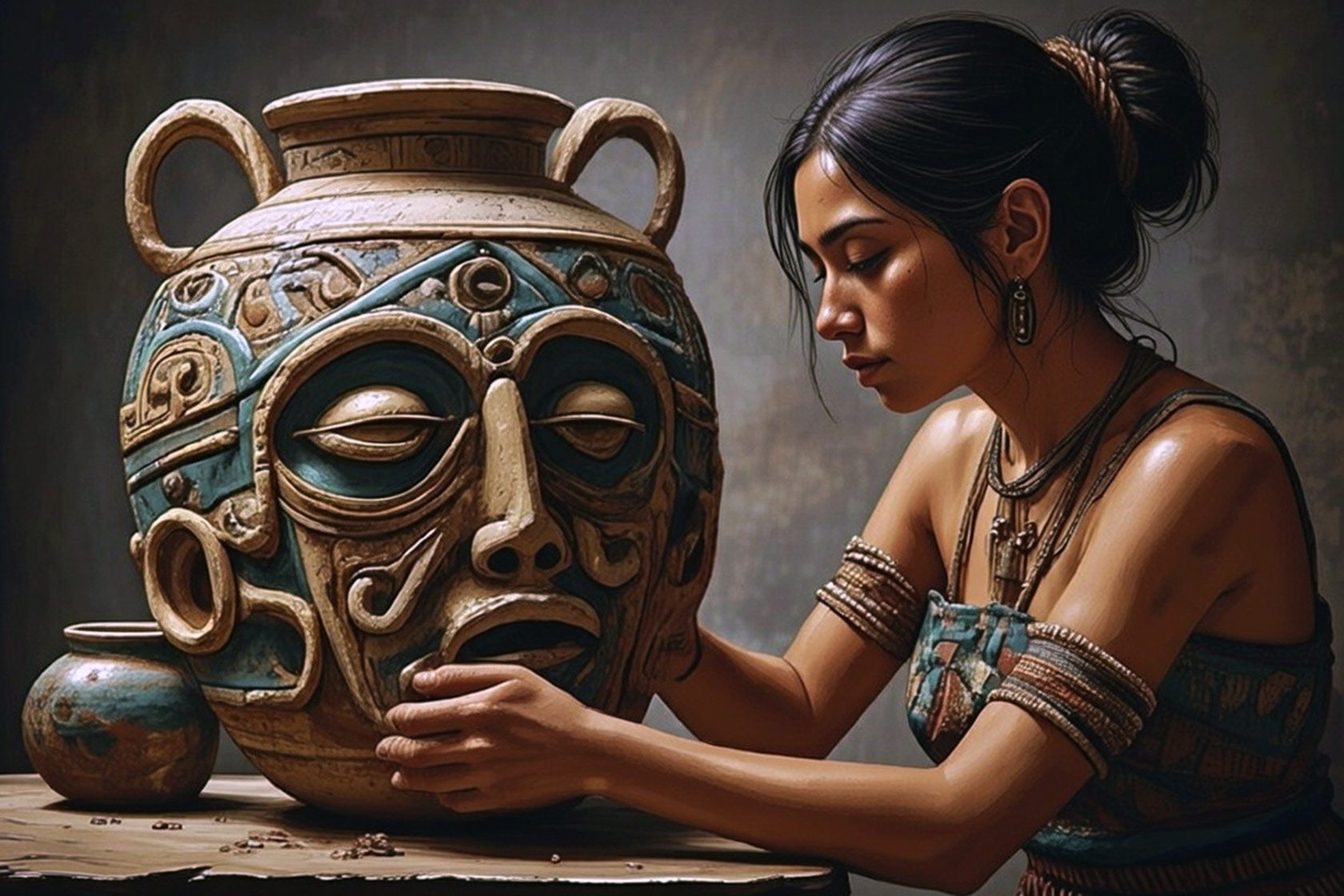
The Moche Potter


Dlds: 32
Status: active
The Moche Potter
The Moche (also known as Mochica) culture, which flourished along Peru's northern coast from roughly 100‐800 CE, produced some of the most technically sophisticated and artistically expressive pottery in the ancient Americas. Their ceramics stand out for their remarkable realism, narrative depth, and innovative forms, offering an unparalleled window into Moche society, rituals, mythology, and daily life.
Moche pottery (also known as Mochica ceramics) features a highly distinctive and iconic type of handle/spout combination that has a specific name in archaeological and art historical terminology: the stirrup spout (or stirrup‐spout handle, often called a stirrup spout vessel when referring to the whole form).This is not a conventional handle but a hollow, U‐shaped (or arch-like) tube that connects to the vessel body at two points, with a vertical cylindrical spout rising from the top center of the arch. The design resembles a horse‐s stirrup (hence the name), and it serves dual purposes: as a handle for carrying or holding the vessel and as a spout for pouring liquids. The hollow tube allows liquid to flow through either side while minimizing spillage, evaporation, or contamination.
Grok
Moche Culture, WikiPedia
Smoke On the Water, Gamazda
Nothing Else Matters, Gamazda
Stairway To Heaven, Gamazda